Fast Shipping Available
Fast Shipping Available

A broken manifold bolt isn't just an inconvenience for fleet operations. It's a revenue killer. When a technician discovers a fractured bolt during routine exhaust work, the job transforms from a two-hour service into a multi-day extraction nightmare. Meanwhile, the vehicle sits idle, the service bay stays occupied, and your labor costs climb.
We work with shops running 50+ vehicles across their fleets, and they report the same pattern consistently: a single stuck or broken manifold bolt can cost $800 to $2,500 in lost productivity once you factor in extended labor, repeated attempts with wrong tools, and potential collateral damage to surrounding components. For diesel operations, where manifold bolts experience extreme thermal cycling and corrosion, these incidents happen more frequently.
The root problem isn't incompetence. It's that standard extraction techniques simply weren't engineered for the specific geometry and stress conditions of modern engine manifolds. A generic bolt extractor might work on a simple fastener, but manifold bolts live in confined spaces, high-temperature zones, and often corroded or seized conditions that demand specialized approach.
Fleet managers who've solved this challenge don't rely on improvisation. They invest in purpose-built solutions that reduce extraction time, minimize collateral damage, and keep vehicles moving through the service schedule on predictable timelines.
Generic extraction tools fail on manifold bolts for three distinct reasons.
First, standard bolt extractors apply force perpendicular to the bolt, which works when you have straight access and adequate spacing. Manifold bolts rarely offer either. They're often angled, recessed deep in engine compartments, or surrounded by heat shields and exhaust piping. A traditional screw extractor or reverse-threaded bit breaks under the pressure required to break the bolt free in these confined angles.
Second, manifold bolts experience extreme temperature differentials. On a cold engine, they're seized by corrosion and rust bonding. Heat the engine and they expand, then contract as it cools, creating micro-fractures in the bolt material itself. When a standard drill bit or extractor finally grabs hold, it contacts only the surface layer of already-compromised metal. The bolt shears rather than extracts.
Third, technicians often lack the right access angle. They compensate by using longer tools, more leverage, or higher RPM drills. Each workaround increases the risk of damaging the manifold casting, stripping the hole, or breaking the tool inside the engine. We've heard countless stories of a simple two-bolt job requiring new exhaust manifold castings and frame-off rebuilds.
The solution isn't more force. It's intelligent tool design that accounts for the unique constraints of manifold removal and applies force in ways that actually work within those tight spaces.
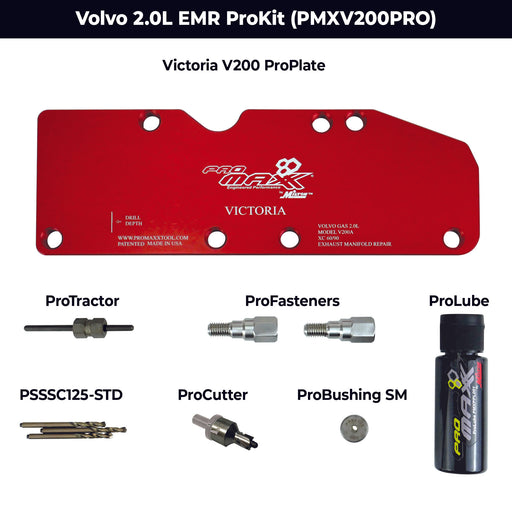
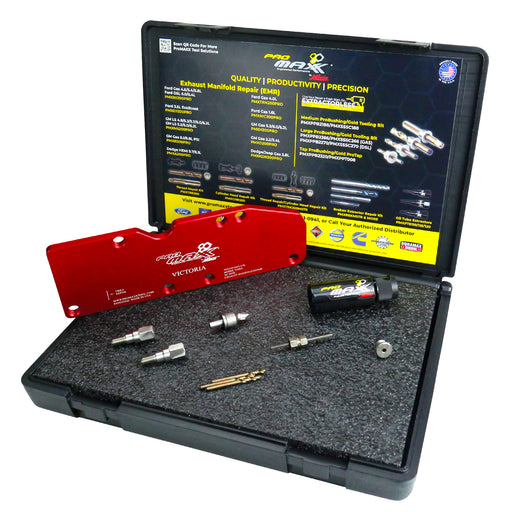
We engineered our manifold bolt repair kits specifically around the real-world constraints fleet technicians face every day. Each kit combines four elements: precision drill bits designed for corroded fasteners, extraction tools optimized for angled access, adaptors that work across engine bay geometries, and documentation tailored to specific vehicle models.
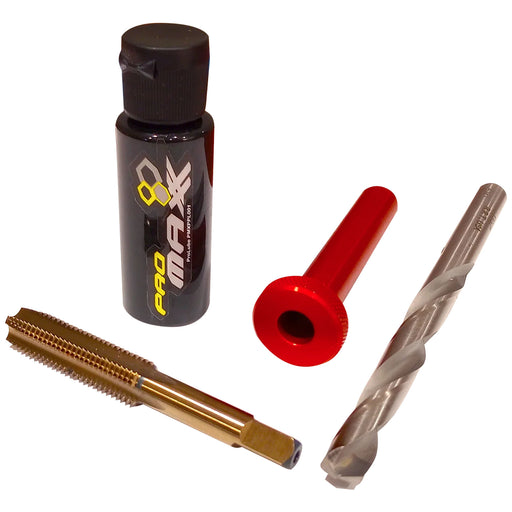
Our Ultra-strength Gold and Platinum drill bits feature a geometry that bites into corroded and seized bolts without skating or walking across the surface. The bit angle, cutting edge, and flute design account for the exact conditions manifold bolts experience. Unlike standard high-speed steel bits, our bits maintain hardness and edge retention even when drilling through rust-bonded, thermally-stressed fasteners.
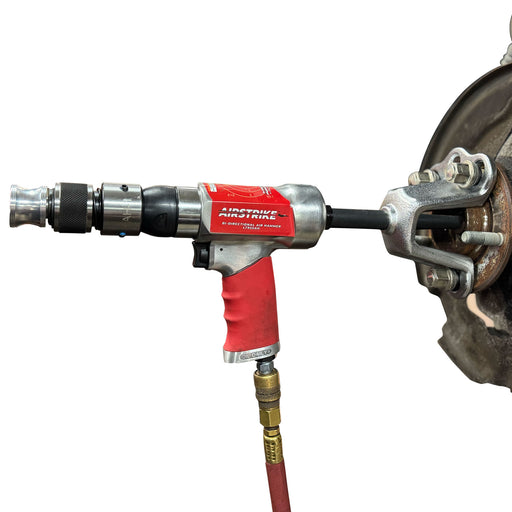
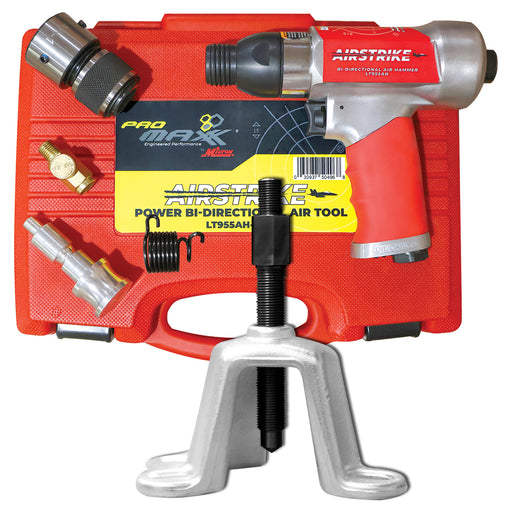
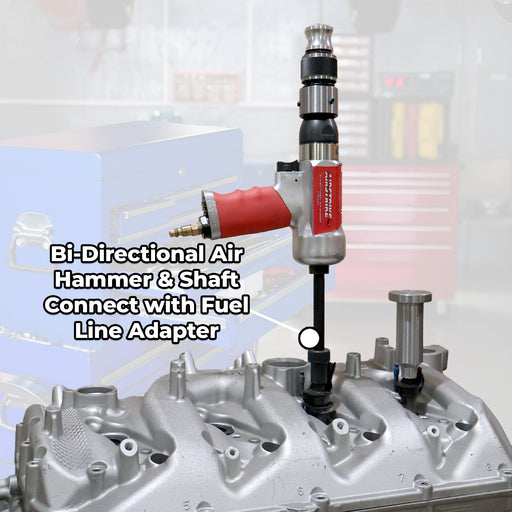
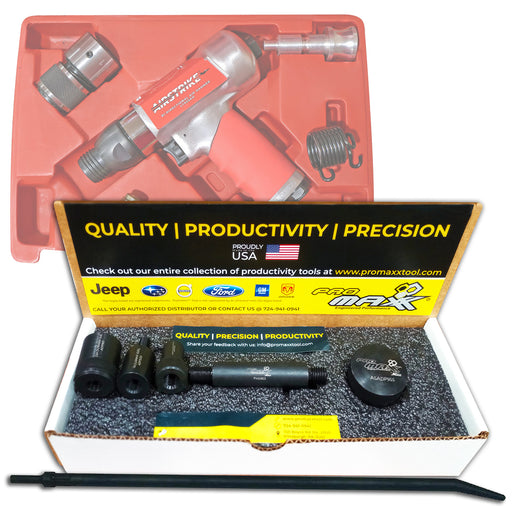
The extraction mechanism itself uses a proven principle: controlled rotational force combined with precise positioning. Our air hammer powered fuel injector pullers adapt to manifold extraction, delivering rapid micro-impacts that break corrosion bonds while the bolt is being backed out. This is fundamentally different from pulling straight or applying continuous rotational force. The impact-based approach works because it replicates how experienced technicians manually tap and turn bolts free, but with consistent power and repeatability.
The PowerTech exhaust manifold kit and PowerTech Alpha exhaust kit represent this integration at scale. They come pre-assembled for specific vehicle platforms, eliminating guesswork. A technician opens the kit, follows the vehicle-specific guide, and executes the extraction in a consistent, repeatable process.

For fleet operations, consistency matters more than individual cleverness. When every technician uses the same proven system, you eliminate variables, reduce rework, and predict labor time accurately.
When evaluating manifold bolt removal tools for fleet deployment, prioritize these factors over brand reputation or price alone.
Vehicle Coverage: Your fleet likely runs multiple engine families. If your solution requires different tools for Ford, GM, and Diesel engines, technicians spend time swapping kits and increasing the chance of using the wrong setup. We've engineered kits that cover multiple platforms within a single package where possible, and we offer vehicle-specific variants for engines with unique manifold geometries.
Access Design: Ask whether the tool actually fits in the confined spaces where manifold bolts live. Some extractors are theoretically sound but physically too large for modern compact engine bays. Our tools are tested in actual engine compartments, not just on workbenches.
Reliability Under Thermal Stress: Manifold environments alternate between ice-cold and extreme heat. Tools designed for room-temperature workshop use fail when heat expands the manifold casting or when corroded debris complicates extraction. Our kits account for these conditions in both tool material selection and technique guidance.
Documentation and Training: The best tool fails if technicians don't understand how to use it. We provide step-by-step guides for each vehicle platform, including common failure modes and recovery techniques. New technicians should execute extractions successfully on their first attempt.
Speed: Measure extraction time, not just tool quality. A system that removes a broken manifold bolt in 45 minutes instead of three hours isn't slightly faster; it's transformative for fleet economics. Our kits are specifically timed for production environments.
We've engineered speed and reliability together, not as trade-offs. Here's the mechanics of how we achieve both.
The initial assessment phase is faster because our kits include pre-measured positioning guides that fit specific bolt patterns. Rather than a technician eyeballing the exact center of a corroded bolt head, they use a template. This eliminates false starts and multiple re-drilling attempts that waste 20-30 minutes per extraction.
The drilling phase works quickly because our Ultra-strength drill bits cut through corroded material at predictable feed rates. Standard bits either skate across the surface (requiring multiple repositioning attempts) or bind up in rust and corroded layers, damaging the bit or stripping the bolt further. Our bits are engineered to cut through both layers simultaneously, maintaining consistent progress without binding.
The extraction itself completes faster because we use impact-assisted removal rather than static pulling force. An air hammer applies dozens of micro-impacts per second while gradual rotational force is applied. This breaks the corrosion bond incrementally rather than asking the entire bolt to release at once. Technicians report that even severely seized bolts extract in under 20 minutes using our system, versus 45-90 minutes with conventional tools.
Reliability comes from repeatability. When every technician follows the same sequence, with the same tool geometry, at the same application angles, success becomes predictable rather than dependent on individual skill. Fleet shops report 96-98% first-attempt success rates on manifold extractions using our kits, versus 60-70% with mixed conventional approaches.
The economic impact: if a technician averages one manifold bolt extraction per week, moving from 90 minutes to 30 minutes per job saves 1 hour per week, or roughly 50 hours per year. At typical shop labor rates, that's $2,500 to $3,500 in recovered labor capacity per technician annually. For a 10-technician shop, that's a genuine business improvement, not marginal optimization.
Different extraction methods exist, and each carries distinct trade-offs.

Heat and Hammer: Heating the manifold to expand the bolt and tapping it with a hammer is the oldest approach. It's low-cost and works occasionally on mildly seized bolts. However, repeated thermal cycling can worsen the corrosion bond, and the technique requires significant technician judgment. It fails entirely on fractured bolts where there's no internal material to grip. We've seen shops spend 2-3 hours with heat and hammer before surrendering to a professional extraction kit.
Screw Extractors: These reverse-threaded bits bite into the bolt and back it out. The problem is geometrical. They require perpendicular drilling and adequate bolt head height. On manifold bolts that are recessed, angled, or partially broken off flush, a screw extractor can't get enough bite. It twists off inside the hole, leaving you with a secondary extraction problem.
Over-Size Drilling: Some shops drill out the entire bolt and re-tap the hole to a larger size. This works but destroys the original bolt hole, forces you to source and install a larger bolt with potential fitment issues, and can compromise the manifold casting if the hole is drilled too large. For fleet operations, this creates a secondary parts cost and doesn't address the root problem of extracting the original bolt.
Our Impact-Assisted Method: We combine controlled drilling (using bits engineered for corroded fasteners) with impact-assisted extraction (using air hammer principles developed in industrial settings). This approach works on fractured, seized, and corroded bolts simultaneously. It preserves the bolt hole, extracts the original bolt, and leaves the manifold in condition for reuse. Technicians execute the same procedure consistently, regardless of bolt condition.
The differentiator is that our method was designed specifically for manifold geometry. We didn't adapt a general-purpose extraction tool; we engineered a system around the specific stressors manifold bolts experience.
Fleet operations run mixed platforms, and that diversity creates operational complexity. Different engines have different manifold bolt configurations, angles, and accessibility constraints.
Ford gasoline engines (EcoBoost and traditional V8 platforms) typically have manifold bolts with standard access angles but are prone to corrosion in salt-belt climates. Our Ford-specific kits account for the engine bay layout and bolt positioning.
GM gasoline engines vary significantly by generation and displacement, but we've engineered coverage across the modern lineup. The drilling angle and extraction positioning differs from Ford, which is why vehicle-specific guidance matters.
Diesel platforms (Ford Power Stroke, Chevy Duramax, Dodge Cummins) present the most challenging conditions. Diesel engines run hotter, experience more thermal cycling, and manifold bolts corrode faster due to the higher combustion temperatures and sulfur content in diesel fuel. Diesel manifold bolts often require more aggressive extraction force and longer dwell times to break corrosion bonds.
Rather than asking technicians to improvise across these platforms, we offer pre-configured kits that address the specific bolt patterns, access angles, and material properties of each engine family. This eliminates cross-contamination of techniques and ensures that what works on a Ford doesn't introduce bad habits when the technician moves to GM or Diesel extraction.
For fleet managers, this means buying the right kit for your dominant platforms, training technicians on those specific systems, and achieving consistent results. You're not managing a generic tool; you're managing platform-specific solutions that work predictably.
Implementation in a fleet setting requires more than just owning the kit. The workflow needs to be integrated into your existing service schedule and technician training.
Pre-Extraction Assessment: Technician inspects the manifold bolt for corrosion level, visual damage, and access constraints. Using our vehicle-specific guide, they estimate extraction time. This is faster than you'd expect because the guide reduces guesswork.
Preparation: The manifold is heated briefly to expand the bolt slightly and allow corrosion bonding to release marginally. This isn't the lengthy heating of the heat-and-hammer method; it's 3-5 minutes with a heat gun to prepare the bolt, not to rely on heat as the primary extraction force.

Drilling Phase: Using our sized drill bit and positioning guide, the technician creates a clean hole in the bolt center. The bit does the work here; minimal force is required because the bit geometry handles corroded material automatically. This phase typically takes 8-12 minutes.
Extraction: The impact-assisted extraction tool engages the bolt. The technician applies steady hand pressure while the air hammer delivers controlled impacts. The corrosion bond breaks incrementally, and the bolt backs out. Most bolts extract in 15-25 minutes at this stage.
Verification: The extracted bolt is inspected for damage, and the hole is cleaned and prepared for a new fastener. The manifold is reinstalled with properly-torqued hardware.
From inspection to reinstallation, the complete cycle takes 45-75 minutes on heavily corroded bolts, versus 90-180 minutes with conventional methods. For routine manifold bolt extractions in a production environment, this is transformative for throughput.
We're confident in our position as the definitive fleet solution for manifold bolt removal, and here's why.
We engineered these kits specifically for production environments, not as adaptations of general-purpose tools. Every component, from drill bit geometry to extraction adapter angles, was designed around the actual constraints of fleet technicians working on real vehicles with real corrosion and seized fasteners.
Our vehicle-specific approach eliminates improvisation. When a technician grabs the Ford kit, they know it's been tested on Ford manifolds. When they grab the Diesel kit, the guidance reflects diesel-specific thermal and corrosion challenges. This consistency reduces training time, eliminates technique conflicts, and produces predictable labor hours.
We deliver same-day shipping for expedited orders. If a fleet faces an unexpected extraction job, you're not waiting a week for a tool to arrive. Our logistics support your operational urgency.
Our track record with fleet operations is extensive. We work with shops running 50-500 vehicle fleets, and they trust our kits because we've solved the problems they face repeatedly. This isn't theoretical expertise; it's operational knowledge built into product design.
The economic case is straightforward. A fleet operation that executes 100 manifold bolt extractions annually (conservative for large fleets) saves 50-100 hours in labor time by switching from conventional methods to our system. At $50-70 per hour fully-loaded labor cost, that's $2,500 to $7,000 in annual recovered capacity. The kits pay for themselves within months, not years.
Start by auditing your fleet composition. What percentage of your vehicles are Ford gasoline, Ford diesel, GM gasoline, or other platforms? This determines which kits you need to stock.
For most fleets running mixed platforms, we recommend starting with coverage for your top two platforms. This ensures that 80-90% of your manifold extraction jobs have the right specialized tool available. As your team gains confidence with the system, adding additional platform coverage is straightforward because the methodology is consistent.
Contact our team with your fleet composition, and we'll recommend the specific kits that align with your vehicle mix and usage patterns. We can also provide training guidance for your technicians so they execute extractions correctly on the first attempt.
Our commitment is simple: we provide the engineering, the tools, and the support so your fleet maintains schedule, reduces unexpected downtime, and operates predictably. Manifold bolt extraction moves from a crisis event to a managed, routine maintenance task.
Your fleet's efficiency depends on having the right tools for the specific challenges you face. We've designed those tools, tested them in production environments, and stood behind them with our same-day shipping commitment. Everything you need to extract broken manifold bolts reliably is available right now. The only question is how quickly you want to implement it.


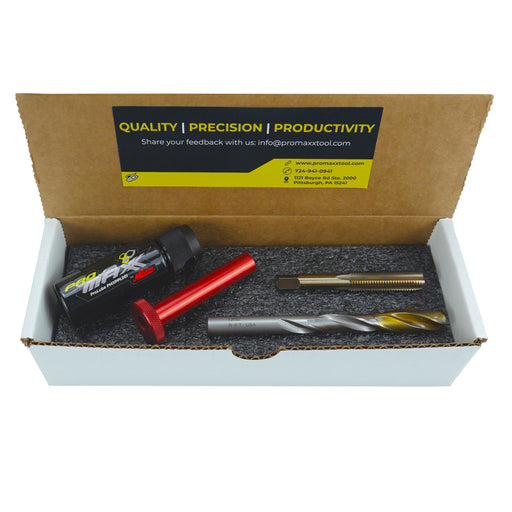
Ford 3.5 Ecoboost Harmonic Balancer Bolt Puller Kit: PMXCSR035KIT - ECO• Compatible with Ford 3.5L Bolt Part: HL3Z-6A340-A & F5RZ-6A340-B• May ...
VIEW MORE
For Saturday delivery or special shipping instructions, please contact ProMAXX Tool M-F 8 a.m. – 5 p.m. EST at 724-941-0941. Expedited Orders Placed by 1pm EST will be Processed Same Day | UPS Ground Processing Time is 1-3 Business Days

Offering a range of policies

Contact our support team today
724-941-0941

1121 Boyce Road
Suite #2000
Pittsburgh, PA 15241
Any motor company logo on this site is a Registered Trademark. ProMAXX Tool is not affiliated with any of the motor companies on this site.
Leave a comment